Wednesday, August 10, 2016

A Mosaic Artist Wanders Around Austin

My workshop with Katerina Pinosova wrapped up in three days, leaving me two and a half days to explore Austin, TX for the first time.  I wasn't sure where to start, so I headed to Blue Moon Glass Supply, because it came up in a search for mosaic in Austin.  There, I met Jim and Rose, and they made me a list of sites to visit, along with the names and contact information for two local artists.

The first mosaic I found was in Shipe Park at a public pool.  It is called "Day in the Park" and was a community project.  I love the design!


From there, I drove to Deep Eddy Pool.  They charged a fee to enter the pool, and I'm cheap, so I took these photos through the fence:

That was another community project commemorating the history of the park.  I couldn't get close enough to the plaque to give proper credit.  It is much bigger than my photos depict.

I continued to walk on the path past the pool and it led me along the Colorado River.  It was a lovely walk, full of people out enjoying nature.  It was there that I began to fully appreciate the city of Austin.
I took this from the bike/pedestrian bridge that crosses the river.
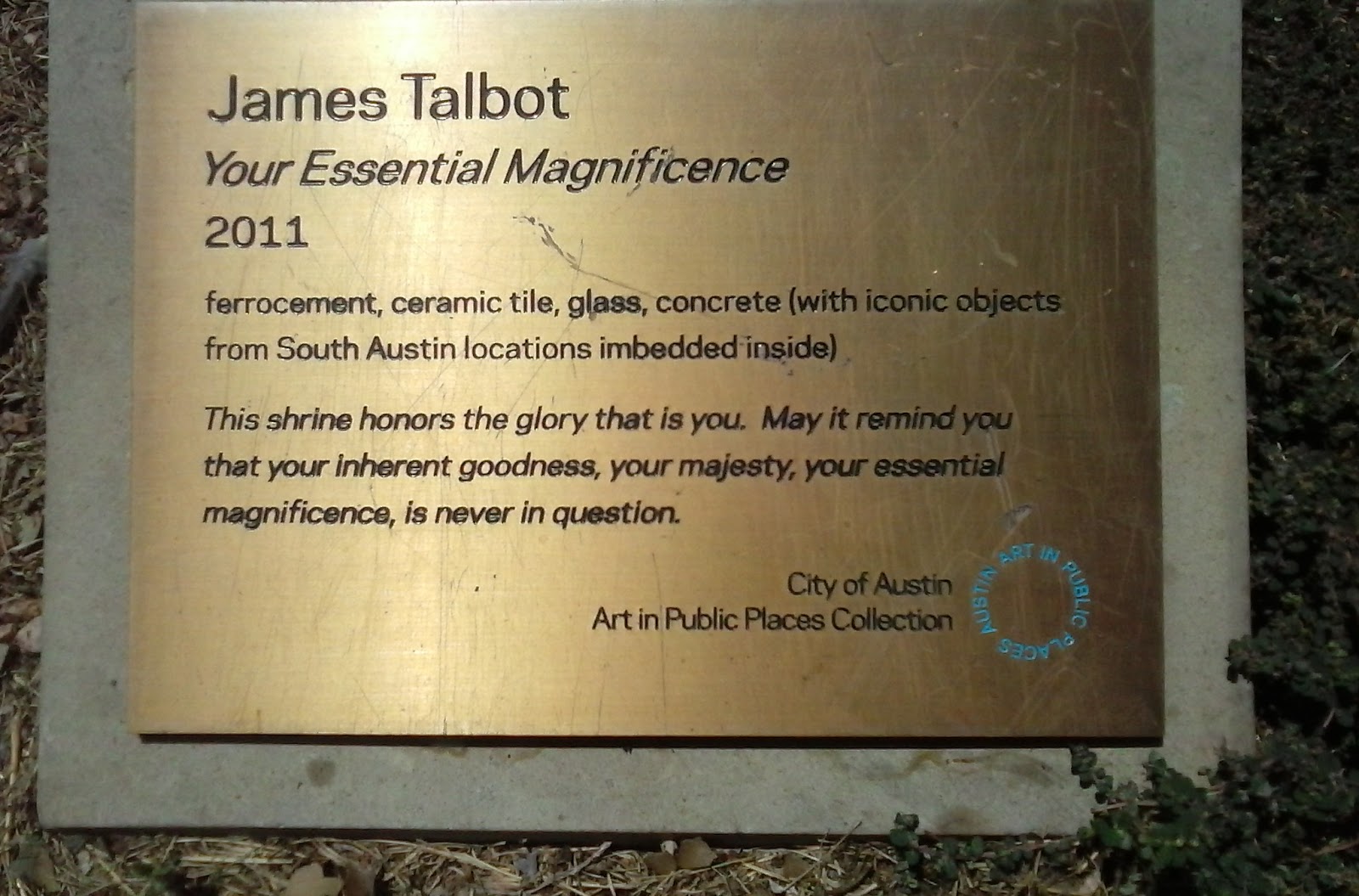
From there, I found a sculpture called "Your Essential Magnificence" made by James Talbot.  I had not felt certain how I wanted to use my new concrete sculpture skills until this point.  I needed to see more work like this.


It was past lunchtime by then, so I stopped at the Magnolia Cafe, just around the corner.  From there, I called the two artists on my list and left awkward messages.  I had never done anything quite like it before, calling strangers in a strange town to ask if I can visit.  Suvi Aika called back immediately, and she was less than two miles away, so I went in search of her home: Casa Wonderlandia.


My photos don't express the magic of Suvi's home.  There are Wonderland-themed accents all around.  The exterior walls of her house have large gears mounted on them.  (I learned later that they light up at night.)  She has landscaped the alleyway next to her house and created a little fairyland.  The photos above include things around her home, and a project she created at a local elementary school for their courtyard.

When I left Suvi's house, I visited a project at Barton Springs Elementary that is fantastic.  A short, but long retaining wall is covered in handmade tiles and glass celebrating Austin and the neighborhood.


I tried to find one more location after that, but a stalled train blocked my path.  I was saturated anyway, so I headed back to my room in Lakeway to process my experience.

I'm stopping here for now, but the next day was even more fantastic, so stay posted!

Concrete Sculpting with Armature Workshop

Earlier this summer, I wanted to apply for a scholarship that would provide funds for professional development, so I was searching online for a potential workshop.  One of the skills I would like to build into my repertoire is creating 3-D forms.  I'm inspired by the work of Nikki de St. Phalle and Jolino Bessera, among others.
 Queen Califia Park in San Diego
I happened upon the website of Katerina Pinosova, a surrealist artist who works in a variety of mediums, including concrete.  There was information about workshop instruction, so I sent her an email.
Sculpture by Katerina Pinosova

I learned that Katerina currently resides in Austin, TX, but that she is considering moving back to the Czech Republic very soon.  I decided to take a leap of faith and schedule a workshop with her while she was still in the U.S.

So, last week, I flew to Austin.  I had to rent a car and drive to an outlying area called "Lakeway" where I had booked a room in an Airbnb less than 2 miles from the workshop location (Katerina's house.)

Katerina is tall and lean with large, bright green eyes and a beautiful smile.  She had everything prepared in a carport, and we got to work right away.  On the first day, she showed me how to build an armature from supplies that are easily found at a hardware store.  We cut thick fencing apart, bent the rods into a basic shape, and used tie-rod to hold it to itself.  Then we layered chicken wire onto the form, securing it with tie-wire, and winding wire throughout the form to add extra structure.  Katerina seemed to be able to go for hours without tiring, but my right hand was aching by the end of the day, no longer functional.  We decided to let my hands rest and finish in the morning.
My armature.
So we started early again on the second day.  Within a couple of hours, my armature was completed.  Honestly, I had expected to be more of a natural than I was.  This was my 4th concrete sculpture workshop, after all, and I thought my chicken shape would be more well-formed.  But, the technique was much harder than I expected, and the chicken was much more rudimentary than I had intended.  By then, I was melting in the heat and my hands were throbbing, and I didn't much care how my chicken turned out as long as I gleaned the information to try again at home.

The next stage was applying a thick cement mix, just to create a basic shape.  In the heat, we had to mix small batches and work fast, and sweat was pouring off of both of us.  When I took off my gloves the first time, I was shocked to see water pour out, and my fingers shriveled like morel mushrooms.
First layer.
We took a lunch break while the mud hardened, only for 2 hours.  When I got back to Katerina's house, we resumed mixing cement, this time with finer sand mixed wetter, and applied two more layers to create a smooth crust.  We mixed so many batches of cement that we wore right through the bottom of the mixing bucket!  By the end of the day, I was completely exhausted.
This is just as I began to apply the final layer of cement.
On the final day, we started a bit later because there was only one layer left to apply.  This time, we mixed white cement with fine sand, and had to take extra care to smooth it consistently.  Katerina showed me how to add fine details. When I added eyes, my chicken suddenly came to life, and I was thrilled!  I had made a chicken planter because I knew I couldn't take my project home, and the folks I stayed with had a small flock of chickens and a little garden in their backyard.  The planter will go to their house after it cures for a month.
Add caption


Katerina on the left, me on the right, and one of her sculptures center.
I'll write more about the fantastic adventures that followed during the rest of my trip in separate blogs.  Stay posted!

Sunday, April 24, 2016

Why Papercutting?

Growing up, the grandparents I was closest to were Polish and Lithuanian.  My mom grew up in a very Polish neighborhood in Saginaw, MI, and while the demographic was becoming more diverse when I was young, there were still Polish and Lithuanian friends and relatives to visit throughout the area.  However, I didn’t learn Polish and knew very little about my own heritage.  Honestly, I wasn’t interested.  Living in a completely Caucasian area of MI (farther North) I found that I was attracted to everything outside of my limited experience.  I loved all things African and (East) Indian.  My high school art projects featured people with rich brown skin and colorful clothing full of patterns and layers or cities with onion dome architecture.

These are both drawings from the late 80s.
After graduating high school, I moved as far away as possible to the West Coast and got myself enrolled in a non-traditional college along with many other privileged, idealistic white kids trying to understand how to improve the state of things (and a handful of non-white students.)  Most of my classes were about culture and social politics; Native American Studies, Islamic Art and Culture, The Politics of Representation, etc.  I continued to fixate on cultures very different from my own, convinced that mine held nothing of interest.  In my view, I came from a small-town, white background, where my culture consisted of cheap beer, potato chips, Country music, deer hunting, and a vigorous fear of outsiders.  In one of my seminars, I received feedback from fellow classmates that I needed to take a closer look at my own culture and find value there.  They pointed out that my focus on exotic-to-me culture was a form of racism.  I took it to heart, and thus began a two-decade-plus search for my own cultural identity.
European and Scandinavian culture hasn’t always been easy to embrace.  It means aligning myself with people whose history is punctuated by the violent conquest of more peaceful communities.  It seems that the migration to colder climates resulted in a sort of ruthlessness, hardness, and desperation.  However, by exploring the folk traditions of my heritage, I found a softer side that celebrates connections to nature.
Traditional Lithuanian Tree-of-Life papercut.
In 2012, I discovered Polish and Lithuanian papercut art (Wycinanki in Polish) and I found it enchanting.  I bought a how-to book and began to practice cutting paper with my own twist on the designs. 
One of my first papercuts from late 2012.
Papercutting is something I’ve been doing once in a while, keeping my projects stashed in a file, but not showing them publicly.  I kept researching my Scandinavian/Baltic heritage through myth, legend and folk arts, and the imagery began to creep into my mosaic work more and more. 
Matryoshka - glass mosaic.
Then, in January 2015, I had surgery and had to take two months off from mosaic.  I spent most of my time researching Lithuanian mythology and practicing papercutting, which I could do comfortably while sitting in a recliner.  My thought was that I was creating design concepts for mosaic, once I was well enough to get back to the studio.  However, I had become hooked on papercutting, and I continued to create these designs with gusto.

In March of 2016, I finally took a papercutting workshop from Alisa Lahti in Seattle.  I discovered her while attending the Seattle Polish Festival, and have been following her beautiful work since then.  The class was excellent, and I now use appropriate paper and techniques to get more detail and delicate lines.  I’m still a baby at this medium and I often spend hours cutting a design, only to inadvertently cut off an essential element, or realize that my positive/negative spaces didn’t work the way I anticipated.
This is the papercut I made in Alisa Lahti's workshop.
I call the above design Zemyna, after a Lithuanian Earth deity.
By working in papercuts, I have reduced my designs down to essential lines, simplifying and distilling my style.  Through this practice, I have connected with my ancestry in a positive way, as well as finding my unique voice as an artist.  In the interest of brevity, I’ll write about why I find depth and meaning in folk arts another time, but this post is focused on papercutting specifically.  
This is a wall in my stairwell showing just a few of the papercuts hung together.

I love how they look together.  They are more visually consistent than some of my mosaic work, where I explore several different approaches and materials.  However, I am determined to stay focused on this style, so that my mosaic exhibits have the same thematic consistency (but with texture, color and durability.)
Mosaic: Eostre made of stained glass, beads, ball chain and glass tile.
So many people coming to Arts Walk this year were surprised to see a different medium from me, and asked, “Why?” that I felt compelled to write it out.  That may have been my first and last papercut show in Olympia, but I’ll keep making them.  I love it!

*2018 Update: I'm still doing papercutting on the side, and one was recently made into a metal banner that is installed on Capital Way in Olympia, WA, where the Capital campus meets the South Capital neighborhood. (The original design is still available, too.) I've shown my Wycinanki work more in recent years and I taught a workshop last summer at the Sitka Center for Art and Ecology on the OR coast. I'll be teaching it again in Auburn, WA on June 23rd. It has great potential as a print or to be cut from metal or wood as public art or even garden art.


*Amazing paper artists to follow:  Alisa Lahti, Q.Cassetti, Andrea Dezso (I linked each name to the website.)

Sunday, January 24, 2016

JK Mosaic: Looking back at 2015

2016 is well under way, but I'm finally getting around to a 2015 Year in Review.

Last year started with a major surgery, so I took January and February off, which gave me an opportunity to simply sketch and play with mosaic at my own pace and to my own delight.  I set myself up in the family room, propped up on pillows, surrounded by art supplies, the tv remote, and painkillers.  I've always been interested in my Polish heritage, as I was particularly close to my Polish grandpa.  But I've found a lot less information about the Lithuanian traditions from my grandma's homeland.  During my convalescence, I happened to watch a Booze Traveler episode about Lithuania, and I was completely enchanted!  As my narcotic intake lessened, I was able to take up some research from some keywords I learned in the episode, finally finding a little bit of information about the religion and mythology of the country, taking copious notes in my sketchbook.

An early sketch I had made the previous year was developed further, and when I was able, I began work on a mosaic.  First, I created a small piece playing with the design style, colors and materials I had in mind:
"Fine Feathered" sold at the MAI salon in Philadelphia.

Later, when I was able to be upright for longer periods, I spent 10 weeks completing a mosaic in a style that is rooted in folk art, yet very much my own.
32.5" x 23.5", Available for sale!
As soon as I was recovered, I was commissioned to fabricate a stone floormat for a L'Occitane in Banff, Alberta.
This is the floor, tile taped on mesh, ready to install.
In April, I attended the annual Society of American Mosaic Artists conference in Philadelphia.  It was a great trip, full of workshops and presentations that inspired me, and allowed me to immerse myself in total mosaic geekery with hundreds of others from the U.S. and beyond.  Unfortunately, I became very ill during the trip, but it didn't stop me from finally visiting the amazing Magic Gardens created by the legendary artist Isaiah Zagar.
This is just one little view of a complex of rooms and a huge courtyard, not to mention many of the areas buildings.
My next project was another lavender farm mural for a L'occitane shop in the international terminal of the Dallas Fort Worth airport.
I was not able to get a shot of the installed mural, but this is how it looked assembled on my floor.  It was about 15' x 4.5'.

In August, I completed a smaller project, embelleshing stair risers into and out of the courtyard of a private home.
The same home has a much larger set of stair risers down to their waterfront, completed in 2011.
Finally, I was commissioned to fabricate my largest mosaic to date for a shopping plaza in Walnut Creek, CA.  Michael Kruzich, an accomplished mosaic artist from San Francisco, graciously helped me with the challenging installation in November 2015.

That wraps up my 2015.  I am currently taking commissions for March 2016 and beyond.  Happy New Year to all of you!

Wednesday, December 2, 2015

How long did it take you to make that?

Years ago, my income relied on gallery sales, summer art festivals, and holiday bazaars.  At some point, commissions began to pick up and I was getting into more exhibitions, and I found that it was no longer cost effective or satisfying to make a ton of "affordable" artwork on the off chance that someone would buy it.  And I was missing out on a lot of weekend and holiday activities with my family in exchange for a few hundred dollars here and there.
My booth at an early art festival.
These days, I'm doing more large commissions throughout the year, with time between to make art for fun.  Some of my projects are for our house, and others are set aside for the next show.  Without current gallery representation or regular art festivals, I've collected far too much work that I really need to sell, so I'm looking at art fairs that might be a good fit for me.

But there is one question I hear over and over, usually from non-customers (those folks artists call "looky-loos.")  The questioner looks at the price tag on the item, skeptically eyes the artwork, and asks, "How long did it take you to make that?"  I try to give my best estimate: "Ten weeks?"  "Two days?"  The person dons an expression that conveys that it is too expensive.  Commonly, I get, "Hmm."  And they walk away.  I'm pretty sure all artists have gotten used to this, and have learned to just keep smiling and focus on the next potential customer.

Here is what I would like people to know:
An independent artist has far more overhead invested in a single piece of art than the hours spent making it.  First, I can make ten pieces before one sells.  When the work is not commissioned, you just make what you like and hope someone out there will agree, and that you and that person will somehow find each other.  So often, when someone buys a larger artwork from me, it is after having seen it in local shows for 2 or 3 years.  They tell me how it spoke to them, they thought about it a lot, they saved the money and finally felt ready to buy.
Me with a very early piece about climate change; Memory of Ice.

In addition to that time put in, there is overhead.  There are materials to buy.  People sometimes question me because I salvage my materials - so why is that a factor?  I can only salvage a portion of the materials, and there are always adhesives, grout, hanging hardware, etc. that give the piece structural integrity.  Also, salvaging takes a lot more time than simply purchasing items new.  I've driven two hours to Portland to go through a glass stash before it was tossed, and I've been given tubs of disgustingly dirty glass or tile to sort through.  It takes patience, commitment, and a lot of time.

Other overhead includes the cost of a studio, tools, professional development, insurance, business licenses, promotional materials, jury fees (astonishing expense), booth fees, taxes, office supplies, a reliable vehicle (can't haul art on the bus), and travel costs for workshops and exhibitions.  If I sell work through a gallery, I will receive only 50% of the sale.  Therefore, I need to be sure to add that cost at every sale/show because it is extremely bad form to have work at a gallery costing twice what I ask in person, and gallery contracts forbit it.  That commission covers the gallery's overhead, and actually does the same for the artist when we sell our own work.
At work in the studio.
You may wonder how it is even possible to earn a living as an artist?  I will be honest with you, and I think everyone should be more open about this: I know very few artists actually making a living.  Even the artists I know and admire who are well-known, whose work is outstanding, who are showing in museums at home and abroad - most are able to do it because there is another income source.  Some wholesale their work, creating something that can be reproduced in large quantities.  Some teach classes to pay the bills.  Some are retired on a pension or have a partner whose income covers the essentials (that's me.)  Or, they have a regular job that allows enough time to make art on the side.  Whatever the case, be assured that the pricetag an artist puts on their work does not come close to supporting them and their family.

I am not saying everyone should or can go out and buy expensive art.  It is a luxury.  Just be sensitive and understand how hard it is to put artwork on display and to hear dismissive comments.  If you like it, but it's out of your price range, that's ok.  If you don't like it, that's ok too.  But if you love it and can afford it, please consider supporting artists and crafters.  Those big corporations don't need it, and are doing everything in their power to keep your money instead of using it to provide the makers of goods a liveable wage.

If you made it this far, thanks for reading, and please support your local makers!