Saturday, January 18, 2014

New Workshop: Precision Glass Cutting for Mosaic

For years, I've offered beginner-level workshops, usually based on a simple project like suncatchers, garden mosaic, or pendants.  But I was recently asked if I would consider teaching a more advanced class for students interested in working with stained glass.  I hand-cut most of my glass, and I manage to get very clean lines and smooth curves.  I find this useful when stacking glass on edge, where I can't have shardes poking up:
In the center, clear glass is cut into undulating shapes, then stacked on edge to create hills and valleys.
...and it comes in handy when I want to add Opus Sectile to my andamento:
Opus Sectile is when each section of the image is cut as a solid piece, rather than using small pieces clustered together.
The ability to cut smooth shapes from glass without "nipping" allows me to create very clean lines with specific shapes when I want to.

And using a mix of different andamento styles within one mosaic can have an interesting effect:
The roses in this mosaic are done in Opus Sectile, as well as the lips, eyeballs, and the grey neckline.  The face and scarf are Opus Palladianum and the hair and background are done in Opus Vermiculatum.  For more info on andamento, see this website: http://www.mosaicmakers.co.uk/mosaicstyle.html

My new workshop in Precision Glass Cutting for Mosaic is designed for intermediate to advanced mosaic artists wishing to add sheet glass to their repertoire, or to gain more mastery over their cutting ability.  I'll demonstrate ways to cut curves and narrow shapes, and will bring my ring saw for students to try.  (The ring saw is vital for cutting more deeply into the glass.
Notice how some of the pistils extend into the shape of the adjacent petals.  The ring saw was necessary for cutting into the petals.  Delicate cutting technique was needed to make the narrow, curving pistils.
However, beginners are welcome to attend, and I will be going over the basics of glass cutting as well.  Students will create a small glass-on-glass project with an Opus Sectile design that includes curves.  I will provide some templates, or design your own.  Materials are provided, and I'll have some tools on hand, but I won't have enough for everyone, so I encourage you to bring your own toyo glass cutter, running pliers and breaker-grozier pliers.  Wheeled nippers are optional.  Email me if you need to purchase tools through me, or more information about that.

The first workshop is March 8th & 9th in Manzanita, OR.  The fee is $200.  Register with The Hoffman Center: http://hoffmanblog.org/about-us/contact-us

The second workshop will be May 17th & 18th at Sequoia Gallery in Hillsboro, OR (just outside of Portland.)  Registration info: http://sequoiagallerystudios.org/contact/

I am very excited to teach a more challenging class like this, and I look forward to seeing how my students use the information.  Contact me if you have any questions.

Tuesday, January 14, 2014

Broken Heart Mosaic Workshop in Olympia, WA

Many years ago, I offered one of my first mosaic workshops through a little shop called Whirligig in Downtown Olympia.  The owner promoted the class for me, and she titled it "Broken Heart Mosaic Workshop" because it was right before Valentine's Day and I was setting up a small heart-themed project for students.

I think I had four students, and all had broken hearts.  They spent the day creating heart mosaics from broken shards, pouring out their stories to each other, discussing relationships and processing loss and grief.  I didn't plan it that way.  It just happened, and it was great.

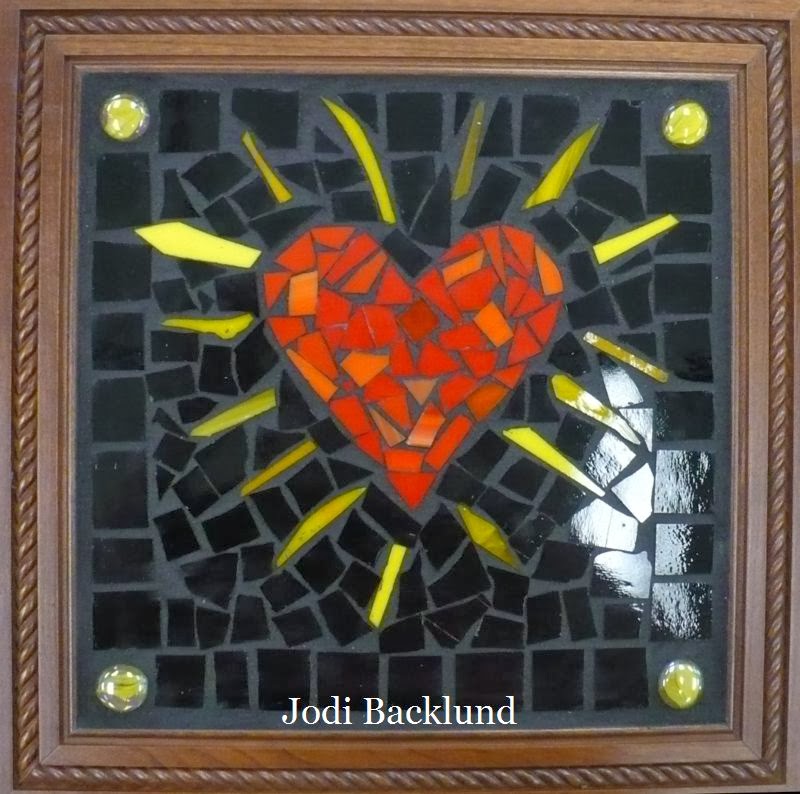
This is not student work.  I made it.
I was never particularly interested in the heart symbol.  It seemed too "cute" and girly to me.  But it was around that time that I started to change my relationship with the Heart.  As a symbol of love and hope, the heart shape may be something we need more of.  Laurel True created a mosaic heart that is particularly inspiring to me: http://truemosaics.com/love-and-truth

After that, I tried to teach the Broken Heart class each year, usually coinciding with Super Bowl Sunday.  Those classes filled up, and were always fun and intimate.  I had found a great stained glass studio that hosted my classes, Hexen Glass, but they closed their public studio a few years ago.  Since then, I haven't taught much, and not locally.  But I recently discovered a new folk art school in Olympia.  I like what they are doing, and I miss the Broken Heart workshop, so I'm finally offering it again this year.
This is a student project.  I love this one.

Here is the description on my website, with a link to registration information: http://jkmosaic.com/broken-heart-mosaic-workshop/

The class will be Sunday, Feb. 9th.  The project can be a gift for someone special or a keepsake for yourself.  I'm hoping for an enthusiastic response!

Friday, January 10, 2014

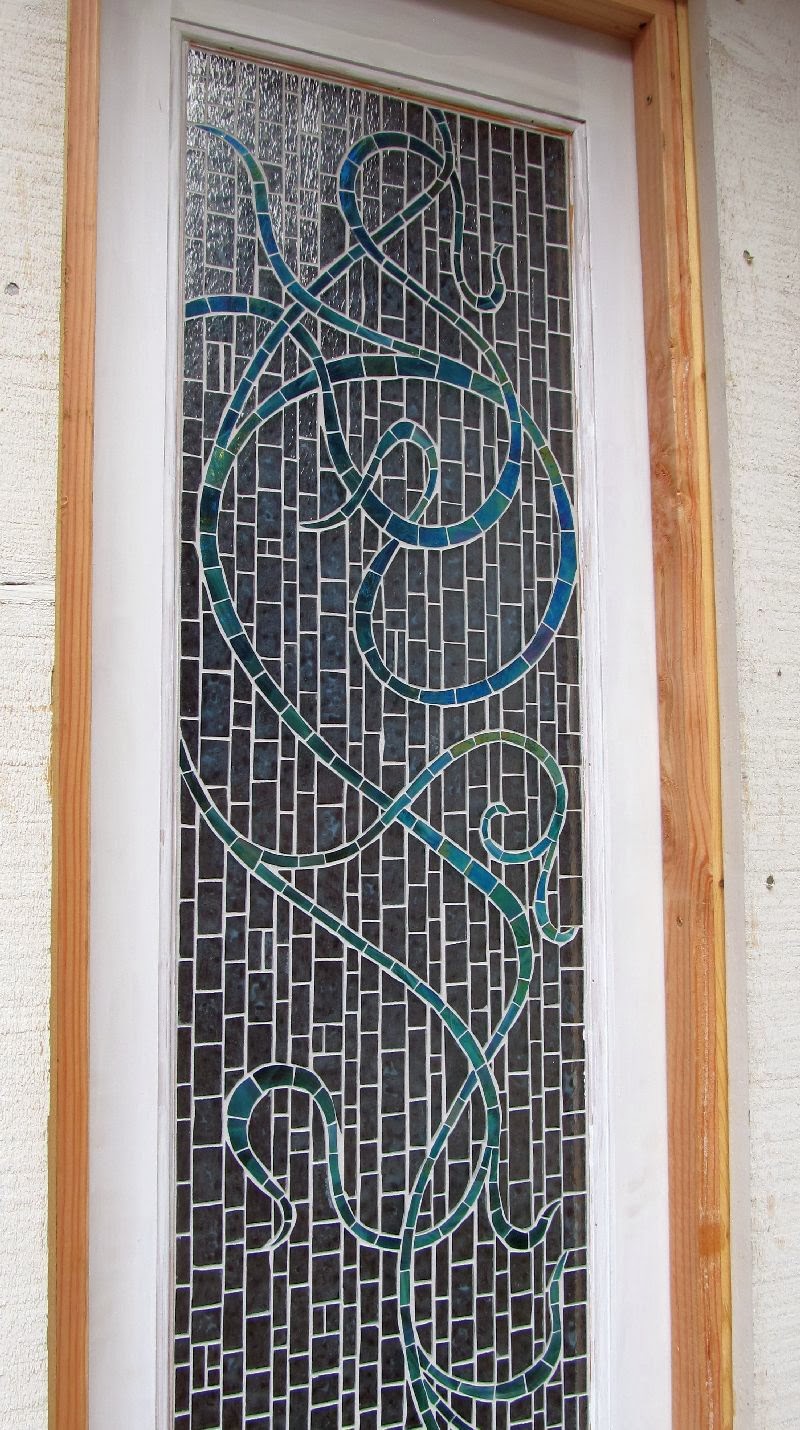
Art Deco mosaic window for entryway


Last summer, we had our wraparound front porch enclosed to become a new "mud room."  This will help hold in heat, and will be a place to store boots, coats, beekeeping supplies, and dogs.  I think it is going to be a great improvement.

A friend salvaged all of the windows we used, and we found a reclaimed sidelight and door.  The door didn't work out, in the end, but I worked from September to the end of November adding mosaic to the 7-foot sidelight, and it is finally in place!


It's hard to get a good shot from the outside, especially since the exterior still needs to be painted.

Photos capture it better from the inside.
Here is a better look at the front.

The Art Zone has taken on a life of it's own!

In a recent post, I wrote about my drop-in art program created to serve homeless and at-risk teens in a rural community.  The class takes place at an alternative high school where regular classes do not take place on Fridays.  Instead, one-on-one meetings take place between teachers and students, teachers do their planning, and students catch up on their studies.

I heard that the small group of seniors that had started coming to my class were staying after school this past week to work on their projects.  I was excited to hear it, but also nervous that they were doing project with no instruction or guidance.  Some had only done one small mosaic project, ever.  No one was telling them how to hold the toyo cutter correctly, how to space and place pieces, what andamento is, or how much glue to use.  My husband left work at 7pm on Wednesday and the group was still there, with a teacher's assistant available to lock up when they were done.  And on Thursday, one teacher was planning to work until 11pm, so the kids made arrangements to stay that late!  (It turned out they were working on their college applications as well, but still...)

So, I was pleased this morning to find a group of tired, but enthusiastic, students waiting for me with their projects already out.  The mural has some remarkably large pieces cut out for the sun's rays, which I would have recommended against, but it is in cured thinset now, and it looks fine.
The student on the left made a sugar skull mosaic, but she has been filling the negative space with paper collage.
I had seven participating students today, which is about as many as I can accommodate with the amount of tools available.  They had Pandora playing at a raucous volume.  Energy was high, there was singing and dancing and a lot of hilarious banter.  The kids talked about how good they feel when they are making mosaic, how they feel calm and happy.

I give them basic instructions: how to use the tools, considerations about color and spacing, application of adhesive, etc.  From there, I let them do whatever they want.  My favorite thing about working with kids this age is that they are capable enough to use the tools safely and independently, yet they aren't restricted by ideas of what mosaic should be, or what they are "supposed" to do.  They try everything.  What if I glue glass onto glass?  What if I put clear glass over images?  Can I layer pieces of glass onto the top of my mosaic?  They think of things it took me years to discover, and they are making their mosaic for the fun of doing it.  Some of my adult students get so hung up on whether they are doing it "right" or what the outcome will be that they become paralyzed and can't glue their pieces down.  These teens just go for it.

This class started so slowly, and there were some weeks that only one person came, and one that nobody showed and I spent the day cleaning and organizing the art room.  I can't tell you how gratifying it is to see the room filled with music and laughter, and new students stopping in to see what's going on.  And they say, "I think I'll come next week.  This looks fun!" 

What a rewarding experience.  I'm so happy!

Saturday, December 7, 2013

Art Zone Update

I've posted a little bit about the drop-in art program that I'm leading at an alternative high school in Shelton, WA, designed to provide outreach for homeless youth.  However, the program is open to all teens, and this school primarily serves at-risk youth, so we wanted to make sure that anyone who needs it feels welcome.

The program started in late September, and it took time to generate interest.  I've had a couple of consistent students, and more kids have noticed the class and become interested over the past couple of months.  But, because it takes place only on Fridays, and some kids only come one time, or once in a month, most are not going to become proficient with mosaic.  Instead, I've learned to set up some really simple projects that can be done quickly, without much effort.  Here is a jar-lid ornament project that was a hit, because kids could stop in, put glass scraps into the lid (over a cut out circle of No-Days adhesive), I used my heat gun to melt the adhesive.  When it cooled, they took it and continued with their day.

I do have a few students who took on a larger Day of the Dead project in October, and they have been diligently working on them over the past couple of months.  Again, the class is only on Fridays, sometimes they have other obligations and can't make it to class, and some students have only an hour or two to spend on it.  I wanted to post photos of the projects when they were complete, but here are progress shots instead:
This student is using tiny pieces because she loves the textured effect.

She is using only wheeled nippers to create her shapes.

This one is actually made by a young teaching assistant who brings a group of students to the class when she can.  She cut out eyes from a magazine and glued them under clear marbles.

This one is being done using indirect method.  The student is learning precision cutting with a glass cutter to make those concave shapes and curves.

This student is trying to use the glass scrap with as little cutting as possible.  She's gathering materials to collage the background.
One student has taken on a 3' x 5' mosaic mural for the school entryway as his senior project.  He has experience cutting glass, and he's quite good at it.
This is the mural as he was creating his cartoon.  The fused glass piece in the center was made years ago when there used to be a real glass art program at the school.  It is being incorporated into the mural as the focal point.  It will be surrounded by trees, ferns, pine cones, sun rays, and lettering.
This school doesn't have regular class on Fridays.  Teachers meet with students to help identify areas they need to improve, independent study takes place, there are often field trips with the outdoor club and organizations meet to work on their projects.  I am often asked to help with creative projects at the school, like decorations for their Haunted House event and a float for the winter parade (we'll all be walking in it tonight!)  Sometimes a group will bring lunch to my room to hang out with a friend who is working on their project.  On one of those occasions, a student mentioned that she wished she knew how to sew.  A couple of weeks later, I took sewing supplies and showed her how to make a little stuffed bird from fabric scraps.  She was so happy!  (Her bird was adorable, too.)

So, this has been a fantastic experience for me, so far.  I like being in an academic setting, working with young people, and hopefully sharing skills that will give some of them a new way to express themselves and a sense of empowerment.

Tuesday, October 22, 2013

Events for late Fall 2013

For years, I participated in holiday sales every weekend in November and December, and earned the bulk of my income making and selling small items this time of year.  Back then, I was Cosmic Blue Monkey Designs and I made art and crafts from recycled materials of all kinds.  My booth looked like the showcase of an arts collective with hand-bound journals, totes made of upholstery scraps, decorative pillows, sweater hats and dresses, and a variety of mosaic items.  Around 2010, my mosaic work had reached a higher level of quality, and I realized I had to focus and do one thing very well instead of dabbling in everything.  I also had to face the fact that the income I earned during the holidays barely covered my expenses, and I felt exhausted by the whole process of making and pricing and packing and setting up and tearing down, as well as being absent from all of the weekend holiday festivities my husband and daughter were enjoying.  It wasn't worth it.
This is the only photo I could find of me tending my booth, several years back.  I'm wearing one of my sweater dresses.

So, I went through a business transformation, re-branding, delving full force into mosaic, and enjoying and participating in the holiday season rather than desperately hawking my wares.  But, I still like to set up for one or two events in November.

First, I'll be attending the Isis International Women Arts Festival for the first time.  I am not sure what to expect, but it looks like there will be visual artists, speakers and performance all day at the Burke Museum on the final day of an exhibit of women artists.  It is only one day, October 27th.
Here is the best link I can find for more information: https://www.facebook.com/isiswomen

A favorite of mine is the POSSCA/Friends of the Library art show and sale.  This year it is November 2nd & 3rd.  Artists pay a commission and proceeds go to support a local arts organization (POSSCA) and the library system.  I love that this fundraiser allows me to earn some sorely needed income while helping to support important organizations.
I don't know if you can read this poster.  This is the only site I can find to link to: https://www.facebook.com/possca
After the POSSCA sale, I'll be taking my work to Swing Wine Bar for an exhibit that will run through November and December.  All of my art panels will be on display, and I plan to have a meet-the-artist event, which has yet to be scheduled.  I'll post when I pin it down.

I do find that participation in events like these gets me out of the hermitage periodically, and I do enjoy the chance to see friends and talk to the public about my work.  It helps me to feel like part of a community, and earning some extra money during the holidays really helps my family.  So, this is the season for prepping and scrambling to finish artwork, organizing what is available, and getting a booth together.  And then off I go to hawk my wares, just a little bit.

Monday, October 14, 2013

Learning new mosaic skills

This is the first post of my new, separate mosaic blog.  For years, I've kept a blog at cosmicbluemonkey.blogspot.com.  I started it as an online journal when our house was being built and became a chronicle of the process of homesteading in the country while raising a child and building a business as an artist.  But, sometimes I feel like the writing jumps back and forth between posts about beekeeping, gardening, and tending livestock to posts about art shows and mosaic learning experiences.  It makes sense to me, but I think creating a separate blog for art will give the writing more cohesion.

It has been a very slow year for my business, financially, but I've been busy with a wide variety of events.  I've given lectures and presentations, led group mosaic events, and participated in a number of exhibits.  I realized recently that this has really been a year of learning and growing as an artist.  While I intended to keep honing my particular style and technique, opportunities to learn new skills keep popping up, and I've been grabbing them by the horns.

In August, I spent four days in Hillsboro, OR with Lynn Adamo.  First, I attended her hammer & hardie workshop and learned to use a tool that had been sitting in my studio for a year.  The hammer & hardie is the original tool used to chop stone into small quadrangles for all of those ancient Roman and Turkish mosaic masterpieces.  It continues to be the tool of the masters in Italy.  After a captivating presentation by Rachel Saeger (rachelsagermosaics.com) at the mosaic summit in Lexington, KY, I ordered my own H&H, thinking I could teach myself to use it (though Rachel warned us in the lecture that it really requires hands-on instruction and lots of practice.)  And, I did find myself unable to break stone or tile with any consistency.

But, in two days of instruction on positioning and the correct inflection of the wrist, how to avoid muscle fatigue, and practice with just about every type of material, I was chopping stone and glass into little squarish shapes!  And I can't tell you how gratifying it is to open a piece of stone to find the surprises inside.  All of the tiny facets that emerge are so textural, organic, and interesting, and I am having fun piecing them into abstract designs that have a completely different look from anything else I've done.
During my stay with Lynn, I also helped to complete a large fish for her new installation in Astoria, using smalti.  Because the material is fairly expensive, I rarely work with smalti, a colorful handmade glass that is usually chopped into square chunks.  But I love the look of smalti and this chance to practice working with it, along with seeing the nuts and bolts of creating a large-scale mosaic that will be inlaid over a concrete pad, was very educational.  Lynn was meeting the challenges of creating the mosaic on mesh in sections that would ultimately fit together seamlessly, and I had the opportunity to be a witness as she brainstormed some of the glitches as they came up.  What a great experience to participate in a project like this without being the person responsible for the outcome!  All the fun with none of the stress.
That's me, working with Richard Davis.  Lynn Adamo took this photo and she has blogged about the whole project.
While chatting with Richard over smalti, the topic of pebble mosaic naturally came up.  I love the look and practical application of pebble mosaic, but I've been reluctant to add it to my repertoire because it is ONE MORE THING and I feel like I should be focusing more rather than less.  However, Richard offered to give me a basic overview of the process, and how could I pass that up?

So, last weekend, I headed to Whidbey Island and learned to make pebble mosaic.  The difficulties in making pebble mosaic include collecting stones, which is illegal in many places and expensive to buy them.  The other aspect is the weight of the slabs when they are made in forms, which is the method I learned.  The pebbles are placed in the base of the form, concrete is poured, and it is flipped over so that the pebbles become the surface.  Flipping and moving the finished mosaic requires a lot of strength.  
Here is the mosaic laid out in the form, before pouring concrete.  
Despite the foreseeable challenges involved in pebble mosaic, I'm very excited and grateful for this new information, and I can't wait to add to our garden walkways.  I started collecting stones from the creeks on our property yesterday.  All of it is black, and it's going to take many trips to the creek over many weeks to collect enough to get started, but I am undaunted.
The edge of my creek, full of smooth stones.
So, I find that this has been a year of acquiring new skills and honing the ones I had.  I expect winter to be an incubation period, as it almost always is, and I look forward to seeing what will emerge in the spring.