Sunday, January 24, 2016

JK Mosaic: Looking back at 2015

2016 is well under way, but I'm finally getting around to a 2015 Year in Review.

Last year started with a major surgery, so I took January and February off, which gave me an opportunity to simply sketch and play with mosaic at my own pace and to my own delight.  I set myself up in the family room, propped up on pillows, surrounded by art supplies, the tv remote, and painkillers.  I've always been interested in my Polish heritage, as I was particularly close to my Polish grandpa.  But I've found a lot less information about the Lithuanian traditions from my grandma's homeland.  During my convalescence, I happened to watch a Booze Traveler episode about Lithuania, and I was completely enchanted!  As my narcotic intake lessened, I was able to take up some research from some keywords I learned in the episode, finally finding a little bit of information about the religion and mythology of the country, taking copious notes in my sketchbook.

An early sketch I had made the previous year was developed further, and when I was able, I began work on a mosaic.  First, I created a small piece playing with the design style, colors and materials I had in mind:
"Fine Feathered" sold at the MAI salon in Philadelphia.

Later, when I was able to be upright for longer periods, I spent 10 weeks completing a mosaic in a style that is rooted in folk art, yet very much my own.
32.5" x 23.5", Available for sale!
As soon as I was recovered, I was commissioned to fabricate a stone floormat for a L'Occitane in Banff, Alberta.
This is the floor, tile taped on mesh, ready to install.
In April, I attended the annual Society of American Mosaic Artists conference in Philadelphia.  It was a great trip, full of workshops and presentations that inspired me, and allowed me to immerse myself in total mosaic geekery with hundreds of others from the U.S. and beyond.  Unfortunately, I became very ill during the trip, but it didn't stop me from finally visiting the amazing Magic Gardens created by the legendary artist Isaiah Zagar.
This is just one little view of a complex of rooms and a huge courtyard, not to mention many of the areas buildings.
My next project was another lavender farm mural for a L'occitane shop in the international terminal of the Dallas Fort Worth airport.
I was not able to get a shot of the installed mural, but this is how it looked assembled on my floor.  It was about 15' x 4.5'.

In August, I completed a smaller project, embelleshing stair risers into and out of the courtyard of a private home.
The same home has a much larger set of stair risers down to their waterfront, completed in 2011.
Finally, I was commissioned to fabricate my largest mosaic to date for a shopping plaza in Walnut Creek, CA.  Michael Kruzich, an accomplished mosaic artist from San Francisco, graciously helped me with the challenging installation in November 2015.

That wraps up my 2015.  I am currently taking commissions for March 2016 and beyond.  Happy New Year to all of you!

Wednesday, December 2, 2015

How long did it take you to make that?

Years ago, my income relied on gallery sales, summer art festivals, and holiday bazaars.  At some point, commissions began to pick up and I was getting into more exhibitions, and I found that it was no longer cost effective or satisfying to make a ton of "affordable" artwork on the off chance that someone would buy it.  And I was missing out on a lot of weekend and holiday activities with my family in exchange for a few hundred dollars here and there.
My booth at an early art festival.
These days, I'm doing more large commissions throughout the year, with time between to make art for fun.  Some of my projects are for our house, and others are set aside for the next show.  Without current gallery representation or regular art festivals, I've collected far too much work that I really need to sell, so I'm looking at art fairs that might be a good fit for me.

But there is one question I hear over and over, usually from non-customers (those folks artists call "looky-loos.")  The questioner looks at the price tag on the item, skeptically eyes the artwork, and asks, "How long did it take you to make that?"  I try to give my best estimate: "Ten weeks?"  "Two days?"  The person dons an expression that conveys that it is too expensive.  Commonly, I get, "Hmm."  And they walk away.  I'm pretty sure all artists have gotten used to this, and have learned to just keep smiling and focus on the next potential customer.

Here is what I would like people to know:
An independent artist has far more overhead invested in a single piece of art than the hours spent making it.  First, I can make ten pieces before one sells.  When the work is not commissioned, you just make what you like and hope someone out there will agree, and that you and that person will somehow find each other.  So often, when someone buys a larger artwork from me, it is after having seen it in local shows for 2 or 3 years.  They tell me how it spoke to them, they thought about it a lot, they saved the money and finally felt ready to buy.
Me with a very early piece about climate change; Memory of Ice.

In addition to that time put in, there is overhead.  There are materials to buy.  People sometimes question me because I salvage my materials - so why is that a factor?  I can only salvage a portion of the materials, and there are always adhesives, grout, hanging hardware, etc. that give the piece structural integrity.  Also, salvaging takes a lot more time than simply purchasing items new.  I've driven two hours to Portland to go through a glass stash before it was tossed, and I've been given tubs of disgustingly dirty glass or tile to sort through.  It takes patience, commitment, and a lot of time.

Other overhead includes the cost of a studio, tools, professional development, insurance, business licenses, promotional materials, jury fees (astonishing expense), booth fees, taxes, office supplies, a reliable vehicle (can't haul art on the bus), and travel costs for workshops and exhibitions.  If I sell work through a gallery, I will receive only 50% of the sale.  Therefore, I need to be sure to add that cost at every sale/show because it is extremely bad form to have work at a gallery costing twice what I ask in person, and gallery contracts forbit it.  That commission covers the gallery's overhead, and actually does the same for the artist when we sell our own work.
At work in the studio.
You may wonder how it is even possible to earn a living as an artist?  I will be honest with you, and I think everyone should be more open about this: I know very few artists actually making a living.  Even the artists I know and admire who are well-known, whose work is outstanding, who are showing in museums at home and abroad - most are able to do it because there is another income source.  Some wholesale their work, creating something that can be reproduced in large quantities.  Some teach classes to pay the bills.  Some are retired on a pension or have a partner whose income covers the essentials (that's me.)  Or, they have a regular job that allows enough time to make art on the side.  Whatever the case, be assured that the pricetag an artist puts on their work does not come close to supporting them and their family.

I am not saying everyone should or can go out and buy expensive art.  It is a luxury.  Just be sensitive and understand how hard it is to put artwork on display and to hear dismissive comments.  If you like it, but it's out of your price range, that's ok.  If you don't like it, that's ok too.  But if you love it and can afford it, please consider supporting artists and crafters.  Those big corporations don't need it, and are doing everything in their power to keep your money instead of using it to provide the makers of goods a liveable wage.

If you made it this far, thanks for reading, and please support your local makers!

Friday, March 20, 2015

Coming April 11 & 12: Beyond Basics Mosaic Workshop in Olympia, WA

Looking at the calendar, I just realized how quickly the next workshop is coming up!  This will be my first time teaching this class; "Beyond Basics," which will address some of the steps a beginner mosaic artist can take to get to the next level.  I've noticed that most mosaic workshops are either project based (make a mirror frame, a flower pot, a stepping stone) or are intermediate/advanced technique-based classes that go deeply into one specific method that the instructor has mastered.  I recently took a short version of Kelley Knickerbocker's "Fundamento" workshop, which was fantastic for taking andamento to new, mind-boggling dimensions.  And I just took a workshop in Philadelphia from Lynn Takata on building 3-D substrates for mosaic, which builds on one that I took from Passiflora Mosaics near Santa Barbara last spring, on building sculptures with a styrofoam base.  Each of these is very specific, and only useful if you have some experience under your belt to put it into context.

Over the past 5 years, I finally accepted that there are some mosaic fundamentals that will go a long way toward improving the composition and flow of a mosaic design.  Reluctantly, I wrapped my brain around these concepts, and after a few years, I realized how much my work had changed.  And I like it.  To emphasize and understand my growth, I re-made one of my favorite designs with new information.
I think this was 2009.  (Note: I had been working in mosaic for 9 years!)
This was 2014.
I still have much to learn, but I think this demonstrates a shift from beginner to intermediate, and I plan to break down the information I've gained as well as I can for this class.

There is so much a mosaic artist learns through trial and error, and from spending the time and money to take workshops from other experienced instructors, that I'll be covering the essentials in this 2-day class, but it won't be possible to convey my 15 years of experience within 10-12 hours.  I'm going to do my best, including an overview of the wide variety of applications, materials, substrates, adhesives and setting techniques used in mosaic art on Saturday.  On Sunday, I plan to get into some of the terminology specific to mosaic, and to delve into types and uses of andamento.  Students will have two small substrates of different kinds, with some materials samples and adhesives, and will be invited to play with each of these to get a sense of them.  You may choose to make a small project, or just use the time to gain information for future use.  Bring a notebook and pencil to take notes and sketch ideas.  When we get into andamento, this will be especially helpful.

I know I already have some absolute beginners signed up for the Olympia class, so I will try to start at that point, but I planned this originally for those crafters who have been playing around with mosaic, but would like some tools for taking their work to the next level.  I hope I can meet the needs of all participants, and I'll make every effort.

Details can be found at the Arbutus website: http://www.arbutusfolkschool.org/current-classes/
Scroll down to April  11/12.  Then on the upper left is a button for "register for classes."
I look forward to working with some of you!

Tuesday, December 9, 2014

Jennifer Kuhns Mosaic in 2014

What a crazy year!  Here's what happened:

February: Janice Arnold, David Tuthill and I put together a proposal for the new Washington State University commencement mace (Vancouver branch), and it was accepted.  We collaborated and worked together so that it could be delivered on May 1st, with some time to spare before graduation.  David did the metalwork, I did the mosaic, and Janice made a felted display pillow that didn't make it into these photos.


At the end of March, I was commissioned by L'Occitane of Provence to fabricate a stone mosaic floor for a new store.  I was about to leave on a trip to MX, so I had only four days to complete it, but I managed to pack and ship it in time.  It was to be the first of 11 floors that I made for them this year, all different sizes, being installed in stores around the country.  I faced many challenges on these, particularly with crating and shipping, but by the end of summer, I had it down.
One of many stone mosaic floors for L'Occitane stores.  If you see one of these installed, please send me a photo!
I installed this Art Nouveau window and floor for my own front door:
Mosaic floor in entryway, with translucent stained glass mosaic window.
In October, I headed down to the first Contemporary Mosaic Artists conference in Ashland, OR, where my work was included in two exhibits of mosaic art.  It was a chance to connect with other mosaic artists from the West Coast, to be immersed in discussions that no one but a mosaic artist would find interesting, and I took a workshop with Kelley Knickerbocker on creative andamento.

I had to rush back from the conference to finish fabricating a 15.5' x 4.5' mural for L'Occitane.  In the middle of October, I flew to Atlanta, GA to install the mural with the help of Krystie Rose Millich, a Colorado mosaic artist and friend.
Mural of a lavender farm made of stained glass for L'Occitane of Provence in Alpharetta, GA.


This book was released this year, by Kay Christy, featuring a mosaic made specifically for the cover:
Buy this book on Amazon: By clicking here!
My first sculptural mosaic, "Fertility," was chosen for the City of Auburn's Downtown Sculpture Gallery.  It was installed in September and will be on display through August 2015.
Fertility - 24" by 18" featuring birds, flowers and a Tree of Life.
Additionally, I managed to make a few new small pieces in my limited spare time.  Here are a few from 2014:
Dia do los Muertos - 15" x 15" currently available

Bouquet - donated to an auction for Doctors Without Borders, which raised over $18K!

City Visit - Currently available

Frida - a commission

Matryoshka - currently available

Window of Compassion - SOLD!

Shiny Things - currently available
This was my busiest year of all time.  More happened than I can list here.  I taught workshops, continued with my weekly program teaching mosaic to at-risk teens, gave a (very short) speech at the Governor's house in Olympia on behalf of Enterprise for Equity, and dealt with some crazy personal stuff on top of it all.  I'm taking a little break this winter, going to Guadalajara for winter break, then dealing with some medical issues in January.  But already, big plans are coming together for 2015, and I'm excited about the year ahead.

Monday, November 10, 2014

JK Mosaic Mural installation story:

Wow, when I logged in here at Blogger, it said that my last post was in February!  It makes sense, because my life went a bit haywire in March.  That is when a large body-care company asked me to fabricate a mosaic floormat on a very tight deadline.  Simultaneously, a close family member began to go through a major crisis, and it all happened within a couple of weeks of a trip to Mexico.  I juggled managing and caring for another adult, tending the farm & family, and working 10-12 hour days on that mosaic in order to have it packed and shipped before our trip.

While in Mexico, I learned that the mosaic did not arrive when expected, and had to track it down for the client, and then that it had gotten pretty banged up in transit.  This was the first of eleven of those floors, between 11 s.f. and 36 s.f. that I created for that company this year.  The third mosaic arrived with about 1/4 of the project missing completely, as in the box must have broken open, the section fell out, and UPS just taped it back up and sent it on it's way.  When I requested it be returned for repair, UPS sent it to some kind of inspection center for six days, during which it was unable to locate the package.  This was a hugely stressful learning experience, after which I began constructing wood crates for all projects, and will never ship through UPS again.  (Their customer service was cold, confused, and unapologetic until my complaint reached a local agent.)

All of the projects created after that arrived intact and, from all I can surmise, were installed without issues.  However, working with a big company has been a strange new experience.  When the project is confirmed, I hunker down over my work table for long hours every day until it's done, build a crate, ship it off, and I'm lucky if I hear whether it went into place correctly.  I have never seen a photo of these floormats after installation, and there is almost no feedback unless something goes wrong.
The floormat changes in size and composition, but is always this basic design, with the company name along the bottom (not included here.)

Around July, this company began inquiring about a large-scale mosaic mural, brainstorming how it would be created and installed.  They wished for me to do the installation, so I began to consider the best way to construct this kind of mosaic.  But, there were delays getting started, my initial bid was too high for the construction budget, and we negotiated until an agreement was reached.  By the end of August, the mural was approved, and I began to plan while waiting for the deposit.  Originally, I requested two months to create the project.  There were some delays, and I said I needed a minimum of six weeks, and I was very nervous that I would not be able to complete a 71 s.f. mosaic within that time - I usually set aside six weeks for a small scale mosaic commission to allow for unforeseen circumstances.

The deposit came through, so I ordered all materials and rearranged my studio to make room for such a large mosaic project.  But then the contractor alerted us that there had to be changes to the building facade, and the new measurements were uncertain.  As this delay continued, I became more and more panicked.  Finally, I convinced the project manager to allow me to have the pattern (a photograph provided by the company) printed to the original scale, and I would adjust after final measurements were confirmed.  At this point, I had exactly three weeks to piece the mosaic together before prepping it for installation, crating, and shipping.

Kory Dollar, a mosaic artist in Vancouver, WA, offered to spend a weekend helping me.  We had never worked together, and I've never had another artist work on one of my private commissions, but I was desperate, and I would not have met the deadline without her help.  A friend of mine with glass-cutting skills, but very little mosaic experience, pieced together the whole green section of a mountain, house, and shrubbery.
Here's Tara, just starting the mountain range.
During the weeks of working on this mosaic, I regretted accepting the commission, or not cancelling when there were delays.  But, I had received money, purchased materials, and if I could actually complete it, I would receive a satisfactory final payment and have a nice mural in my portfolio.  My fear was that it would not be work I could feel proud of, that I would not be able to complete it on time, and that the installation would be so rushed that it would go horribly wrong.  I requested an extension, but was denied.  The new store is part of a whole shopping center, and the entire place had to be completed and open by the end of October.

This was a very hard time for my family.  My daughter is 11, and being unsupervised for hours every day meant that there were daily issues, like an entire bag of marshmallows (meant for occasional bonfires) being eaten in an afternoon, no limits on t.v., homework not being completed - it was a free-for-all.  It was harvest season, and the fresh food in the garden rotted in place.  Normally, this food is preserved and used throughout the coming year.  Honey was not harvested.  The barn and coop did not get cleaned and the animals were neglected.  I lost all but one duck to predators.  We canceled our anniversary plans and I spent no time with my family, which caused stress and resentment.  (My daughter is still mad at me.)  We ate a lot of take-out and processed food, and instead of getting any exercise at all, I spend long hours bent over, straining my wrists and back to reach areas of the mosaic, and destroying my hands with repetitive motion.
Completed mosaic assembled on my floor, before prepping for installation.
The most brilliant move I made during this process was to ask my mosaic colleague in Denver, Krystie Rose Millich, if she would be my installation assistant.  We met at a mosaic summit in Chicago many years ago and had an instant connection.  Since then, we've roomed together at the conferences and traveled to a workshop together, so I know we are compatible.  As it turned out, she was eager to join forces and she was the perfect assistant.  She even took on researching and scheduling flights, rental car and hotel.  We both flew to Atlanta and arrived within a half hour of each other, picked up a car, and found the hotel the afternoon before we needed to be on the job site.  We went to visit the store, which turned out to be a very good decision, as getting in and out of the giant construction zone would be challenging, and we started work knowing what we were in for.  We hit Home Depot that night to stock up on all of the things I didn't want to haul in my suitcase.  And we tried to get to sleep as early as possible, despite a 3-hour time change and my high level of anxiety, which was making me nauseous.  I couldn't stop imagining how I would problem-solve every possible scenario.  What if I opened the crates to find sections damaged?  What if the mural didn't fit correctly?  I couldn't turn my brain off even though I had been awake for 26 hours at that point, flying across the country.

But, on Friday morning, we dragged ourselves out of bed, grabbed breakfast and caffeine, and went to the job site.  There may have been one other woman in sight, and we got a lot of odd looks from the hundreds of male construction workers, as if they thought we might be lost.  The G.C. helped us to get all of our stuff up onto the scaffolding - which was much higher than I expected.  There were some details to go over with the guys to make sure everything squared up before we began dry-setting the mosaic, which took the first half of the day.

I had cut 1/8" wedi into sections, and adhered the mural to the wedi with Laticrete Platinim 254 thinset.  I used white thinset because a lot of my glass was translucent.  Then, I grouted the sections up to the edges.  After dry-setting and making sure everything fit correctly - and it did! - we used locktite construction adhesive and screws to attach the sections to the exterior-grade plywood substrate.
This photo was taken by a news photographer, Jonathan Phillips.
There were some glitches.  While I had no problem interlocking the sections on the floor in my house, it was different on a vertical surface, and impossible where it had to be inset at the end.  I had to bust a lot of pieces off where the seams met, and I found that I had to score and break a lot of the long, flowing sky pieces.  So, we spent the last hours of the first day patching the mosaic with thinset and caulking the edges to fill some large gaps.  As it began to get dark, we packed up and left.  It had been very hard work, climbing up and down that scaffolding, being in very hot sun all day, and doing a lot of lifting and bending.  But, I was absolutely elated that none of my fears had come true.  Everything had gone about as smoothly as could be expected, given the circumstances.

On Saturday, we were sore and still exhausted, so we managed to drag ourselves to the store around 8:30, long after the other workers had started.  But, we knew we would finish by that afternoon.  We had to do some more patching in the morning.  We broke for lunch and to let the thinset set up.  (Normally, I would not grout over fresh thinset, but it was necessary.)  After lunch, we grouted all of the seams and edges.  In direct Atlanta sun, the grout was setting up very quickly, so Krystie Rose mainly kept up with sponging and wiping while I applied grout.  And, by 3pm, with aching arms, we cleaned everything up and left.  Immediately after we got to the ground, a pair of workers who had been waiting all day took over the scaffolding, covered the mural with plastic, and began to do stucco work.
And it was done!
And we still had all day Sunday to spare.


Since my return, I have been catching up on everything that was neglected during September & October and making my own designs in mosaic.  I'm turning 45 later this month, and I feel compelled to reflect on all that has happened lately, and to look forward.  Now that this project is over, I am glad I pushed through it, though I never want to work on such a tight schedule again.  But I now have confidence that I can accomplish large projects proficiently.  I know what I am capable of, and also what my limits are.  This was both an awful and rewarding experience, and I like to think of the quality work I might achieve with more relaxed timelines in the future.

In the meantime, I picked the last tomato from the greenhouse this morning.  The goats' hooves are trimmed.  I'm catching up on all of the doctor and dentist appointments, cleaning the house, and cooking meals from scratch (usually.)  Everything is back in order.

Thursday, February 6, 2014

Mosaic Switchplate workshop coming to Auburn in March 2014

Last spring, my daughter's friend asked me if it would be possible to mosaic switchplates.  You know, the plastic covers that fit over light switches; usually that bland "cream" color, and purely functional.  I wondered why it had never occurred to me to decorate my own switchplates.

Well, for one, they are plastic, and plastic is not an ideal substrate for mosaic.  A mosaic artist would not normally work on a plastic surface.  However, switchplates are small and hard, so there isn't much flex in them.  I started experimenting with adhesives and designs, and began, one by one, covering all of my own switchplates in mosaic.

I made very simple designs:
By cutting glass pieces into random quadrangles, with a "fiesta" palette, I was able to make this quick and easy cover within an hour (not including grout.)

This switchplate is framed with ball chain and filled with various quadrangles in a simple pattern, which looks stylish and elegant.
I also tried making a picture on a switchplate:
This took a few hours and includes a fused glass bird and flower and leaf beads, as well as seed beads for the flower stems.  This would be very difficult for a beginner, and I would have to charge too much to sell them.
I eventually found a happy medium, creating patterns that are fairly simple for me to cut and assemble, yet result in a lovely, unique design:
I think this one is my favorite.  It is in a small bathroom painted bright blue, green, & teal.  The black and white patterned border sets it off, and small millefiori beads are cute accents.

My living room is in these colors, and this came out looking a bit art deco, which I love.  But the cuts and design are quite simple for someone with experience.

This is another simple pattern.  I sold this one at an art show and benefit.

Ball chain and beads, along with a striking color combination, make this switchplate extra pretty.  I sold this at a show.

I wanted to go with a monochromatic palette on this one, rather than bright colors.

I can't get the colors to render properly in this image, but it is another favorite.  It is dark red, opalescent teal, pale pink & purple, shimmering gold, and yellow-greens.
This is just a selection of the switchplates I've made, and I've learned a lot by trial and error in the process.  So, I'll be teaching my technique at a workshop in Auburn, WA on March 15th.  The workshop will cover how to prep the base, appropriate adhesives, creating pattern, introduction to cutting stained glass, and a grout demonstration.  I'll send students home with grout to finish their projects.  Tools are not included in the cost of the class.  Beginner students can get by with wheeled nippers (search online, or go to Home Depot's flooring department.)  But, to make custom shapes with glass, you'll need a glass scorer (toyo glass cutter is my choice), breaker-grozier pliers, and running pliers.  A full set of tools should cost about $45.  If you would prefer, order them from me up to 2 weeks prior to the class (to give me time to get them for you.)

The skills learned in the class will apply to most small mosaic projects, as well, so it is a great introduction to mosaic.  To register:  http://www.auburnwa.gov/things_to_do/arts_entertainment/art_classes.htm

Saturday, February 1, 2014

More good news for the Art Zone!

Last week, an article was published for the Society of American Mosaic Artists newsletter, Groutline, about my art program.  When I wrote it, it was still just getting started.  By the time it was released this past week, the program had grown (as chronicled in previous posts.)

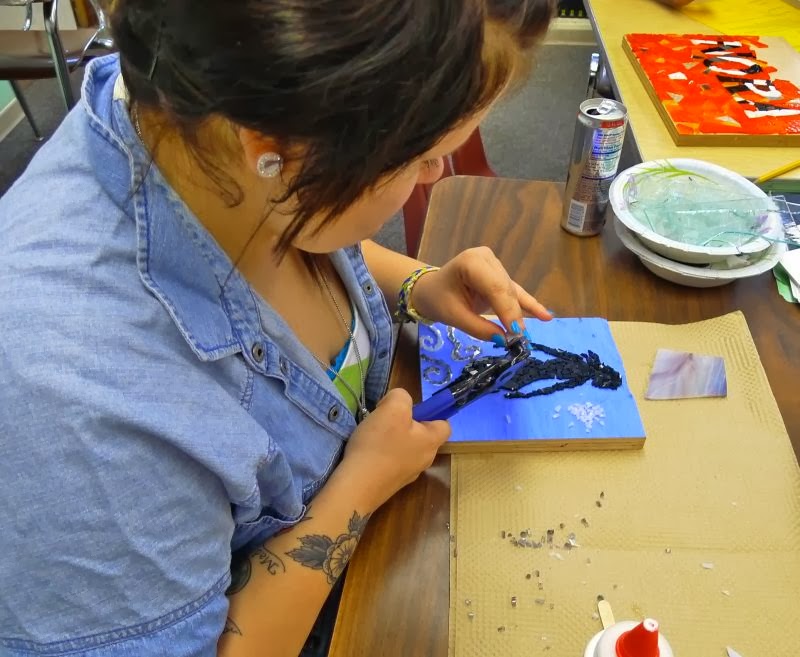
Before I even opened my Groutline, I had a couple of emails asking how people could help.  And when I got to school yesterday, there were two boxes of donated materials waiting!  One was a very large box of glass tile from Patricia Bryant, and the other was a box of beads and ball chain ordered for us by Virginia Lucas.  When I brought out the boxes and explained to the students that people around the country are sending donations for the program, their jaws dropped.  I think the fact that there are people out there who care enough to contribute makes them feel valued, and more committed to the program.

I also had the pleasure of announcing that the students and I will show our work together at Hot Toddy as part of Olympia's Spring ArtsWalk festival.  And my husband will be entering some of their work into a school district art show.  They plan to create work for sale to raise funds for the Choice Cat Club.  We are going to start working on stepping stones and plant pots for spring.
We have a lot of clear and nearly clear glass, so many of the students add images under glass.  This is WA State with Bruce Lee (buried here).  Donnell has a stylized signature, which is the symbol on the left.  If you look closely, he also has a little Seattle skyline in the upper left.

I'm also working on organizing a field trip to tour the Spectrum Glass Factory and visit the Museum of Glass in Tacoma.  All of these things are very exciting.  The district is impressed with the level of participation in the program, and have found some funds for me to use.  I'll be using these for the field trip, to purchase some bright glass colors from a local glass company, and I have a district Home Depot card that I'm going to use today to buy grout, sponges, hanging hardware, a little broom, buckets, and all of those other little things we have been doing without.

It is so exciting and heartwarming to see my students getting this kind of support.  My position is funded by a grant through the McKinney-Vento Act, which serves home-insecure teens.  Many of the kids who participate qualify under the guidelines of the act, but it is open to everyone.  Most of the students at Choice High School are there because they don't fit in at a traditional school, and can be described as "at-risk youth."  They each have faced, and are facing, major obstacles.  This program goes a long way toward empowering and supporting these young people, and gives them new tools to cope with difficult situations.

Thanks, Everyone!